
Why We Invested in PLCs.ai
When the Sputnik moment happened in the late 1950s, the United States mobilized its resources to catch up and win the space race.
Decades later, Japan dominated automotive, electronics, and most advanced manufacturing. We scrambled to adopt their lean, just in time, quality-focused systems and more advanced automation so we would not be left behind. And we pivoted towards more advanced systems: semiconductors.
Fast forward a quarter century and the stakes are even higher. Today the contest is for resilience and independence, this time against China, a far larger force given its scale, its control of many layers of the physical world value chain, and current geopolitical realities. We know we must reindustrialize; the question is how we can possibly compete given our structural disadvantages, including higher labor costs, tighter regulation, and a shortage of experienced operators.
We have to win by being a smarter, more automated, more innovative version of ourselves. Luckily, this is happening at a time when AI is advancing at a lightning-fast pace and opening white space to rethink everything. AI for the physical world, from systems integration to data mining to robotics, will reshape how we compete and win. Modern production rests on control systems that decide when a line starts or stops, how fast a motor runs, and when a sensor reading is too high and triggers an alarm. Those systems were powerful already, but now with AI the possibilities are seismic.
This is the backdrop for our investment in PLCs.ai. They are building the foundational software layer for the modern factory, an industrial grade AI copilot that finally makes complex automation understandable, adaptable, and massively more productive.
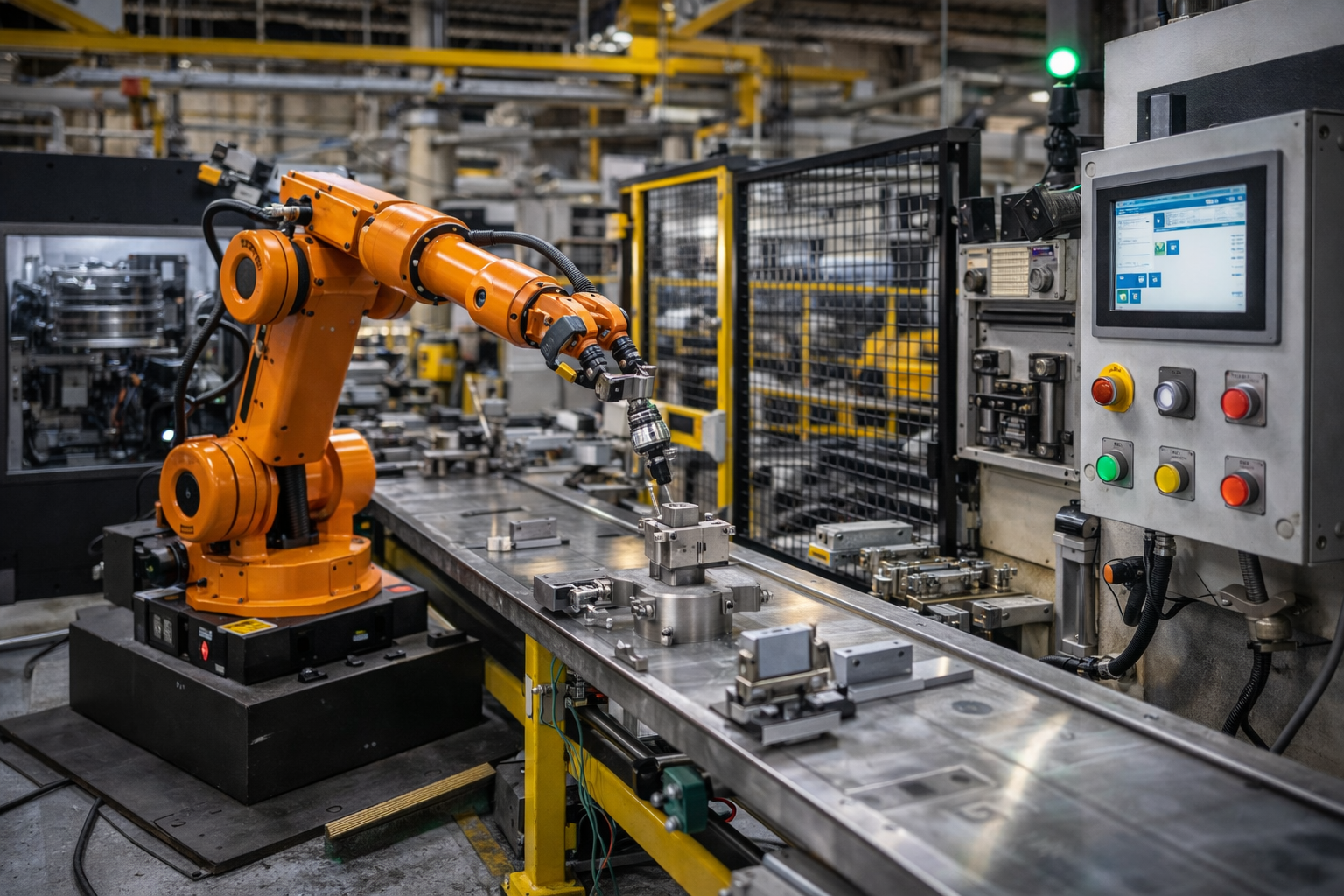
PLCs, or programmable logic controllers, are the rugged little computers that sit on every modern manufacturing line, running mission critical code that is hard to write, harder to debug, and understood by a shrinking pool of specialists. That creates bottlenecks where trivial changes take weeks, downtime is expensive, and tribal knowledge lives in a few overworked engineers’ heads. PLCs are the natural choke point between AI and the real world.
The first act is deliberately simple and fast to deliver value, agentic AI for PLC automation and management across multiple vendors, plugged directly into existing (aka brownfield) sites. Their platform ingests PLC code and plant documentation, then turns that tangled mess into clear, plain language. Engineers can ask questions, get explanations, and generate code changes with an intelligent assistant that understands both the factory and the constraints it must respect. They are running successful pilots with leading global manufacturers in consumer products and automotive, ingesting large volumes of data and delivering a system that engineers on the floor can use easily, effectively, and with low risk.
This may sound like a narrow niche, and that is exactly why we love it. Big transformations often start with a focused wedge where the pain is acute and the value of a solution is obvious. Amazon began with books on the internet. PLCs.ai begins with AI for PLC management. From that beachhead, they can earn trust and then expand. Once you can understand and reliably change PLC code across a plant, you can start to coordinate those systems rather than just document them. PLCs.ai is building toward self-optimizing systems on the factory floor, an emergent operating system for manufacturing that changes how we design, run, and improve production sites. In that future, next generation AI agents will anticipate and prevent disruptions before they occur, continually tune production flows for throughput, quality, and energy use, and gradually render today’s static, fragile control architectures obsolete.
Each deployment creates a defensible and scalable data moat. Every line of PLC code analyzed compounds into a richer set of industrial agents over time. PLCs.ai is not another generic agentic AI. It is deeply embedded in the control layer and adaptive to each industry and step in the production chain. The necessary customization, quality control, and data protection prevents its commoditization by newcomers and/or a generic LLM.
The founders, Zohar and Noam, have both the scars and the ambition to pull this off. They have spent years in and around factories, automation systems, and industrial AI. They understand both the technical frontier and the human realities of selling into large, conservative manufacturers. They are building patiently in the messy, high stakes world where a single error can cost millions, because that is also where the opportunity is measured in trillions.
Backing PLCs.ai is, for us, a bet on the kind of future we want to live in, one where the West regains its industrial capacity not by racing to the bottom but by racing to the frontier. It is a future where AI does not just generate images and emails, but helps us build cars, semiconductors, medicines, and critical infrastructure with higher quality and lower waste. It is about harnessing AI to make the physical world better and to enable us to successfully and competitively reshore the industries that form the backbone of a functioning economy.
We believe PLCs.ai can become the default AI layer that sits between industrial control logic and the people who need to understand and improve it. If you want to help build this or implement it on your factory floor, reach out to them here.
