
Datacenters as Catalysts, not Villains
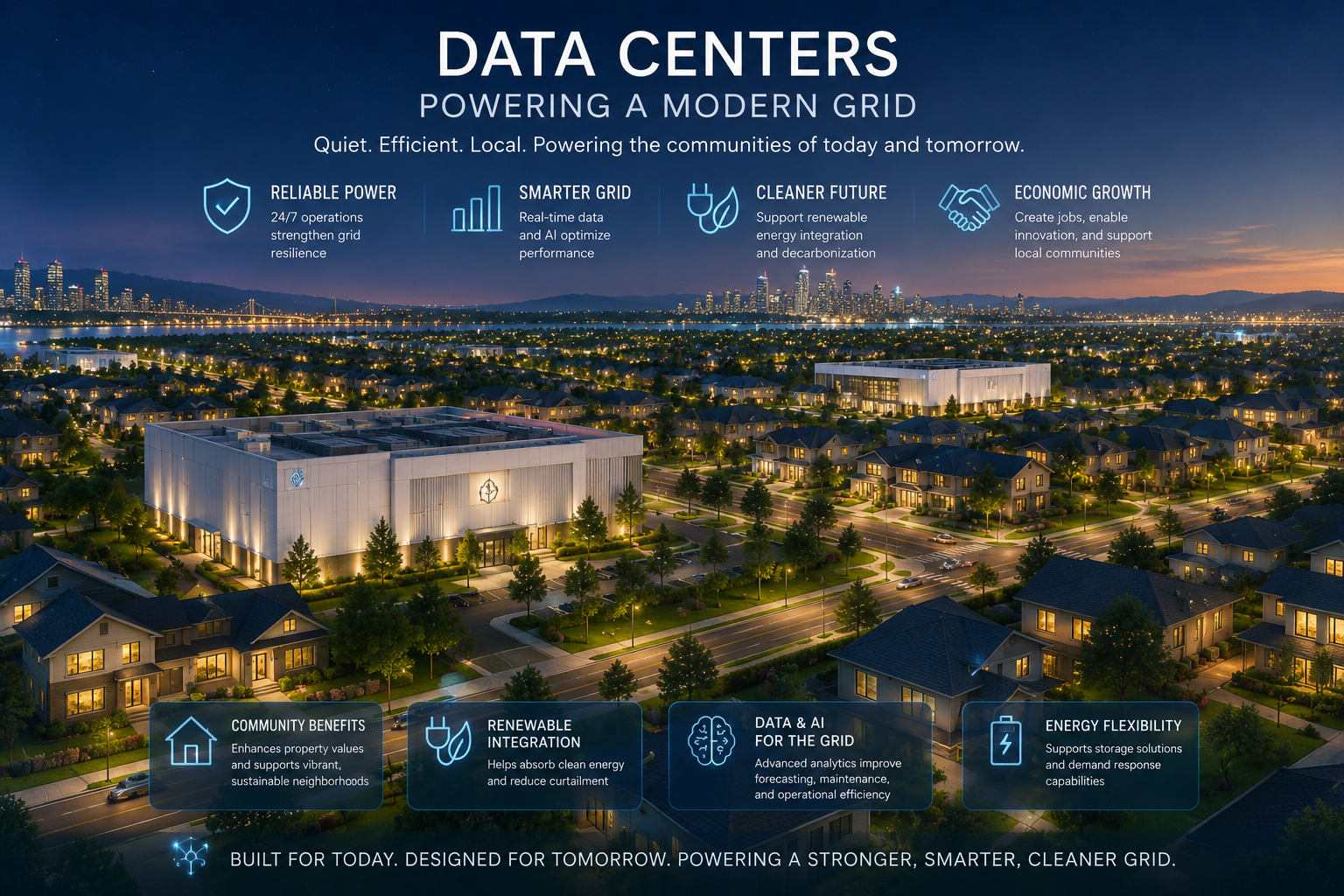
tl;drBy the time we reach consensus on the hardest AI questions, trillions in infrastructure will already be built. We do not need to settle every debate about AI before deciding how the public should benefit from it. Rather than waste this once-in-a-generation investment cycle, let’s strike a narrower grand bargain: make datacenters help fund the grid transformation America needs, and settle the rest later.
A handful of moments in history brought massive capital to build real things that spurred dramatic growth. Previous generations got railroads. Electrification. The interstate highway system. The telecom buildout. Whatever AI’s ultimate impact on our way of life, one thing is already clear: we are in the middle of one of those moments.
Over the next several years, trillions of dollars will be invested in datacenters. The exact shape of the AI future remains uncertain, but the capital deployment does not.
However, the public conversation is stuck.
Some believe AI will usher in an era of unprecedented prosperity and are pushing to forestall any regulation. Others fear job displacement, concentration of power, misinformation, or risks that are harder to define – at the extreme they want to block AI or own it. Both sides are raising legitimate questions. The challenge is that answering those questions and reaching consensus may take years.
But the capital will not wait, and that is the fundamental mismatch at the heart of the current debate. Society is still trying to determine how AI should be governed, regulated, taxed, and integrated into our institutions. Meanwhile, hyperscalers are deploying capital for infrastructure at a pace rarely seen outside of wartime mobilizations, and while detractors might make it more expensive or inefficient, we know they will not be stopped. Rather than a suboptimal buildout hostage to unresolved debates, we should strike a narrower bargain: fast, predictable permitting and interconnection in exchange for binding commitments that every major AI infrastructure project leaves the surrounding community with a stronger, more resilient, and more affordable energy system than it found.
By the time we reach consensus on many of the hardest questions surrounding AI, trillions in physical infrastructure of the AI era will already have been built.
The question is not whether this buildout happens. The question is whether the rest of society benefits from it.
Today, many communities where datacenters are being proposed view those applications with suspicion. At the local level, they have heard that datacenters consume enormous amounts of power and water, create relatively few permanent jobs, and place new demands on local grids. They worry that electricity infrastructure will need to expand, landscapes will change, and utility bills could rise as utilities scramble to keep pace. Many residents struggle to see what they gain in return. From their perspective, the primary beneficiaries appear to be distant technology companies, while the risks and disruptions are borne locally. At a more macro level, opposition reflects broad fears of AI’s societal impacts, understandable at a time of rapid change and uncertainty.
These concerns are real. But they are also causing us to miss something important.
For perhaps the first time in generations, private capital is volunteering to fund large-scale energy infrastructure. The economics of AI are so compelling that the largest technology companies will pay extraordinary sums to get power faster.
Most infrastructure projects generate returns over decades. AI datacenters are different. A year of additional operating time can be worth billions of dollars in revenue and strategic advantage. To a hyperscaler, gaining twelve months of uptime may be worth more than the entire electrical infrastructure required.
The largest new customers on the grid desperately want the same thing the rest of us need: more, resilient, cheaper, cleaner energy. And they want it fast. That is a gamechanger.
This alignment is rare, and we should take advantage of it.
In the current discourse, datacenters are cast as villains: power‑hungry boxes that devour land, water, and electrons, sprouting diesel backup generators, and creating relatively few permanent jobs.
But a much better framing is to recognize that datacenters are unusually powerful tools for fixing the grid. Unlike most new loads, AI datacenters:
Show up with huge, bankable balance sheets behind them, and are willing to pay for speed.
Can sign long‑term contracts that de‑risk new generation and grid upgrades.
Are increasingly willing to fund flexibility in the communities around them, not just on‑site.
Every datacenter fight wastes resources and increases animosity across interest groups. Each side is digging even deeper, moving radically in opposite directions away from the common good. The gridlock encourages datacenters toward suboptimal solutions (like diesel backup and behind-the-meter energy) which cause delays and extra costs, but – let’s be honest – will not stop the train.
The progressive side treats datacenters as an extraction: wealth flowing out of the community, bills flowing in. But energy is the most regressive cost in American life. The poorest households spend three to four times the share of their income on it that the richest do. A grid modernized with private capital while delivering lower long-term costs for households is one of the most progressive economic outcomes we can achieve today. Environmentalists, who often lead litigation against these developments, can appreciate the importance of clean energy for all, subsidized by the private sector.
The conservatives side wants to win the AI race, strengthen domestic manufacturing, and compete effectively with China. None of those objectives are achievable on a grid that cannot deliver abundant, reliable power. Energy dominance is the substrate of AI dominance: without competitive compute we cannot win. And as Satya Nadella recently said, electricity is a bigger constraint today than chips. A bigger, harder grid is national security, supply-chain independence and a manufacturing base all at once.
Stop litigating every datacenter proposal and polarizing the AI conversation. The goal is simpler: every major AI infrastructure project should leave the surrounding community with a better energy system than it found.
That is the national grand bargain we envision. In practical terms, the bargain is simple. Datacenters receive accelerated permitting and interconnection. In return, they help fund new generation, transmission, grid flexibility, and community energy upgrades while protecting existing ratepayers from cost shifting. The larger the load, the larger the obligation.
This bargain does not require agreement on AI.
You can believe AI will transform civilization. You can believe AI is mostly hype.
You can believe the transformation will lead to utopia. Or dystopia.
You can believe AI requires aggressive regulation. Or you can believe regulation should be minimal.
None of those positions are mutually exclusive with building a stronger grid.
Those debates deserve serious attention. But while they play out, America has a narrow window to modernize critical infrastructure using private capital at a scale unimaginable a few years ago.
There may never be another opportunity quite like it.
The mistake would be treating the datacenter boom solely as an AI story. It is also an energy story. And energy underpins economic growth.
The grand bargain is deliberately narrow. It treats the AI datacenter boom as a one-time grid modernization catalyst. It ties fast, predictable permitting and interconnection to concrete obligations that benefit all ratepayers. And it makes these benefits durable: more energy, at lower cost, with higher resilience, for decades to come.
We believe it should outline crisp policy planks centered on three pillars:
Regulatory reform that aligns incentives
Fund the buildout of the grid of the future
Offload existing load and pay communities to upgrade/flex
For detailed policy recommendations under each pillar, see the Appendix.
We won't resolve our disagreements about AI, democracy, or the future of work quickly. We need more information and insight into the future to get clarity, more time and coalition-building to reach consensus in a 340 million person, 250 year-strong democracy. But we can agree on something simpler: the physical backbone of the AI era should leave America with more abundant, more reliable, and more affordable energy than it has today.
The AI boom should not be remembered solely as a technology story. It should also be remembered as the moment we rebuilt the grid. Let’s not miss our shot for privately financed energy abundance. If you’re involved or want to support these efforts, please reach out.
Appendix
Pillar 1: Regulatory reform that aligns incentives
Performance‑based regulation for grid outcomes. Shift a meaningful slice of utility returns to depend on measurable outcomes: net energy delivered, reliability, affordability over time, not just capex deployed. This will be hardest to accomplish, but essential to align the utilities’ interest with the national interest, an essential requirement way past due.
Mandate interstate collaboration and competition. That includes harmonized interconnection rules, transparent queues (perhaps shifting to an “open season” approach), and preventing tax abatements or other incentives for datacenters to choose one location over another at taxpayer expense.
Fast‑track pathways tied to obligations. Give datacenter projects a clear, accelerated permitting and interconnection track if they agree to the grand bargain, and discourage behind-the-meter solutions that do not benefit the collective. While Bring Your Own Generation (BYOG) approaches might be necessary, they must be implemented in concert with consideration for the rest of the grid and ratepayers.
A time-boxed proposal. The framework should be explicitly time‑boxed (e.g. valid for the next 3-5 years) with mandated reviews every few years to refine based on what works.
Pillar 2: Fund the buildout of the grid of the future
New clean baseload. Beyond gas when feasible, support true long-term abundance solutions such as advanced nuclear, fusion, and enhanced geothermal, complemented by quicker-to-deploy solutions such as renewables with storage.
Mandate flexibility (DERs/DERMS) for higher utilization, peak shaving, and backup. Finance deployment of distributed energy resources (home batteries, smart thermostats, heat pumps (above ground and geothermal), microgrids), managed by modern software to rapidly and cheaply increase grid capacity without years and billions in CapEx.
Build with modern power electronics and capacity expanders. deploy superconducting cables, solid‑state transformers, smart meters and other more efficient and flexibility‑enhancing hardware that increase capacity on existing rights‑of‑way instead of requiring endless new corridors.
Pillar 3: Offloading existing load and paying communities to upgrade/flex
The fastest way to “create” new capacity is to free up what we already have. It will be far cheaper and faster for hyper-scalers to fund offloading demand from the grid than to simply add new generation. For example, national labs have estimated that installing geothermal heat pumps in 70% of US buildings could reduce electricity demand by 15% and save billions in new transmission investments. That alone could cover the entire datacenter demand forecast! (This would most easily satisfy the Ratepayer Protection Pledge, which is in the right spirit but has not been fleshed out for implementation.)
To offload demand, the grand bargain should include:
Datacenters funding building and home upgrades. Geothermal heat pumps, that cut overall heating and cooling demand and act as thermal batteries, giving grid operators more levers during peak events. Support shift to efficient HVAC and use of smart thermostats.
Backing virtual power plants (VPPs). The Google–Voltus deal (100 MW of aggregated flexible capacity from homes and businesses in PJM, funded by Google, with participants getting paid) is a template. When a datacenter needs 100–300 MW, some chunk of that should come from programs that literally pay the surrounding community to flex.
Industrial load flexibility. Support electrification and modernization of industrial processes with built‑in load‑shifting (thermal batteries for high-temperature industrial processes, industrial heat pumps for steam, etc.), allowing big users to ramp up when power is cheap and plentiful and ramp down when the grid is tight.
