
Can These Roaring 20s Get to a Golden Age Without Crises?
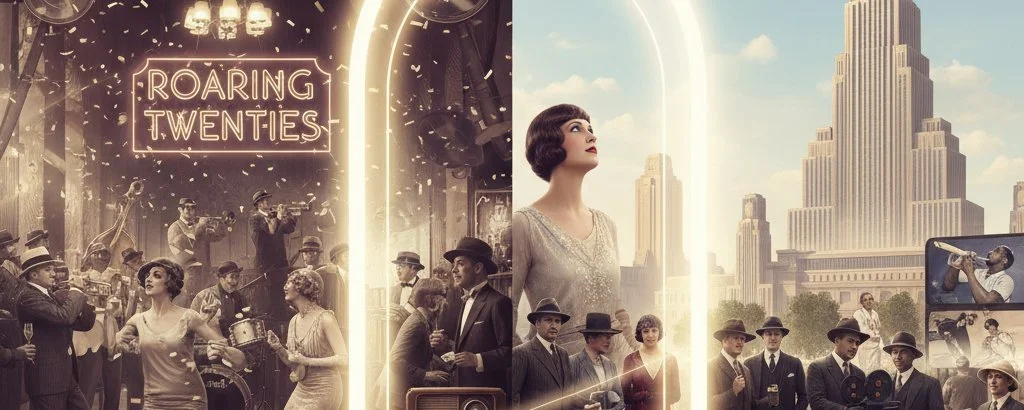
History doesn't repeat, but it rhymes. And right now, the echoes are hard to ignore.
A century ago, the world stood at the intersection of massive transformation: rapid industrialization, geopolitical realignment, and a new global economic order. The promise was extraordinary: unprecedented prosperity, technological progress, and rising living standards. But the path was anything but smooth. The Great Depression contracted global output by a third. Nationalism and protectionism followed. Autocrats rose. The welfare state emerged. And ultimately, the world descended into the most destructive conflict in human history before finding its way to the longest stretch of peace and growth we've known.
The lesson isn't that history will repeat. It's that the future is not preordained. We have far more agency than we think, and the choices that political and technology leaders make during moments of transformation determine whether progress compounds or collapses.
Today, we stand at another hinge point. Three massive, interdependent forces are reshaping the world simultaneously:
Geopolitics: The rise of China echoes the early 20th-century fear of American industrial dominance. Nations are once again redefining security in economic terms, erecting barriers, and competing for strategic control over supply chains and innovation. American leadership matters - not for dominance itself, but because we want the world to subscribe to values of openness, democracy, and shared prosperity. That means we must hold ourselves accountable to those values, not twist them in service of narrow self-interest.
Technology: Artificial intelligence represents a platform shift as significant as industrialization, arriving at breakneck speed. The global economy now rests heavily on AI infrastructure, with interdependence spanning governments, capital markets, corporations, and consumers. Growth is running hot, inequality is climbing, and the bulls assume that technology-led expansion will continue uninterrupted.
Planetary demands: The energy and material needs of this new era are staggering, colliding directly with the urgent need to protect our surroundings. Transitioning to abundant, clean energy and protecting our environment (air, water, land, physical beauty) isn't optional, it's existential.
These forces don't operate in isolation. They amplify and constrain each other in ways that are impossible to predict with certainty. How technology evolves depends on geopolitical decisions. How nations cooperate or compete shapes the planetary transition. And all of it depends on the choices of political and industry leaders navigating fog, pressure, and conflicting incentives.
The mood in equity markets feels familiar. In the late 1920s, stocks soared on the promise of unstoppable industrial growth, valuations defying gravity until reality corrected them. Today's surge, powered by AI exuberance and liquidity, carries echoes of that same conviction: that this time, the productivity curve will justify the price. History suggests optimism is rarely linear.
So, what can we learn?
First, nothing is preordained. Industrialization was real and transformative, but the painful journey through Depression and global war from innovation to prosperity wasn't inevitable. It was shaped by decisions - some wise, many catastrophic. The same is true now. AI's potential is extraordinary, but how it unfolds depends entirely on what leaders choose to do with it. We hold enormous influence over outcomes and must exercise that power responsibly.
Second, the faster the rise, the harder the corrections. Even fundamentally sound shifts carry systemic risk when they outpace societies' ability to adapt. Industrialization displaced entire ways of life - craftsmen, small enterprises, subsistence farmers. AI may do the same to education, services, and knowledge work. Despite the transformative effects of the Internet, the dot-com bubble burst dramatically in between. The transitions from status quo to a new normal are uneven, and often painfully and unfairly distributed.
Third, crises reveal fragility and accelerate change. The Depression triggered political upheaval, labor revolt, and the expansion of state power. WWII cemented this power and shocked our society into a new global order. Similar shocks today - economic, environmental, or geopolitical - could reshape the social contract in ways we can't yet imagine. Capitalism and industrialization thrived under autocracy in the past; there's no guarantee that innovation and democracy move in lockstep.
Fourth, incentives shape narratives. While we think of capitalists as free-market absolutists, they have historically argued for state intervention when it protects their industries and "market forces" when they can dominate without. Investors today are no different. We should be honest about our biases and clear-eyed about whose interests are being served.
Finally, in the fog of transformation, patience and conviction matter most. Staying out of the market in the 1920s would have been devastating; overexposure in the 1930s was ruinous. Timing is impossible. What endures is backing the right people with the right vision over the right time horizon.
At Avila, we've been leaning into these forces for over a decade. We see this moment not as cause for fear, but as validation of our approach: deploy steadily, think in decades, back A+ teams, and stay patient. The noise will be deafening - market swings, policy shifts, technological breakthroughs, geopolitical flare-ups. But the signal remains the same: durable outcomes belong to founders with the talent, vision, and resilience to navigate uncertainty and keep building.
We also believe conviction must be paired with values. The companies we back should take the world toward the future we want to build. One where innovation serves human flourishing, where prosperity is more widely shared, and where planetary constraints are respected, not deferred.
The opportunity ahead is bigger than anything humanity has faced. Three converging supercycles -geopolitical, technological and planetary - may unlock unheard of progress and prosperity. But they could just as easily lead to fragmentation, inequality, and conflict. The difference will be determined by the choices we make now: as investors, as citizens, and as stewards of the systems we're building.
Only hindsight will tell us where we truly stood in this cycle. But we can hope and work toward a path that reaches another golden era of economic progress without first navigating through a crash or a war. The future is not written. As participants in technology, government, and the investment world we have the power to shape outcomes, and we must wield that power with integrity, accountability, and a genuine commitment to the values we claim to hold. It is imperative that America win – but “winning” is only so if the wins are broadly shared, and if it is achieved upholding Western values.
The future is coming at us faster than ever. But each of us has agency to nudge it in the direction we believe in. Ad astra per aspera!
